
Buy LSD Edible 200ug – Sour Grape – Schwifty Labs Online
£165.00
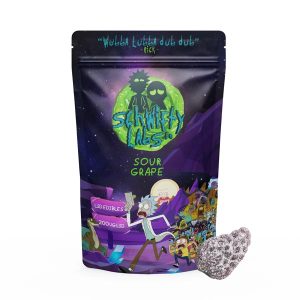
Introducing Schwifty Labs LSD Edible 200ug Sour Grape
- 200ug
- 1 Sour Grape
Do not touch the edible with bare hands, wear gloves or use a tweezer.
In Stock
Description
Buy Sour Grape Edibles
At sufficiently high dosages LSD manifests primarily mental, visual, and auditory hallucinations.Dilated pupils, increased blood pressure, and increased body temperature are typical. Effects typically begin within half an hour and can last for up to 20 hours (although on average the trip lasts 8–12 hours). sour grape edibles LSD is also capable of causing mystical experiences and ego dissolution. It is used mainly as a recreational drug or for spiritual reasons. LSD is both the prototypical psychedelic and one of the “classical” psychedelics, being the psychedelic with the greatest scientific and cultural significance. LSD is synthesized as a solid compound, typically in the form of a powder or a crystalline material. This solid LSD is then dissolved in a liquid solvent, such as ethanol or distilled water, to create a solution. The liquid serves as a carrier for the LSD, allowing for accurate dosage and administration onto small pieces of blotter paper called tabs. sour grape edibles LSD is typically either swallowed or held under the tongue.
LSD is pharmacologically considered to be non-addictive with low potential for abuse. Adverse psychological reactions are possible, such as anxiety, paranoia, and delusions.LSD is active in small amounts relative to other psychoactive compounds with doses measured in micrograms. It is possible for LSD to induce either intermittent or chronic visual hallucinations, in spite of no further use. Common effects include visual snow and palinopsia. In cases where this causes distress or impairment it is diagnosed as hallucinogen persisting perception disorder (HPPD). While overdose from LSD is unknown, LSD can cause injury and death as a result of accidents stemming from psychological impairment. The effects of LSD are thought to stem primarily from it being an agonist at the 5-HT2A (serotonin) receptor, and while exactly how sour grape edibles LSD exerts its effects by agonism at this receptor is still not fully known, corresponding increased glutamatergic neurotransmission and reduced default mode network activity are thought to be key mechanisms of action. In addition to serotonin, LSD also binds to dopamine D1 and D2 receptors, which is why LSD tends to be more stimulating than compounds such as psilocybin. In pure form, LSD is clear or white in color, has no smell, sour grape edibles and is crystalline. It breaks down with exposure to ultraviolet light.
LSD was first synthesized by Swiss chemist Albert Hofmann in 1938 from lysergic acid, a chemical derived from the hydrolysis of ergotamine, an alkaloid found in ergot, sour grape edibles a fungus that infects grain. LSD was the 25th of various lysergamides Hofmann synthesized from lysergic acid while trying to develop a new analeptic, hence the alternate name LSD. Hofmann discovered its effects in humans in 1943, after unintentionally ingesting an unknown amount, possibly absorbing it through his skin. LSD was subject to exceptional interest within the field of psychiatry in the 1950s and early 1960s, with Sandoz distributing LSD to researchers under the trademark name Delysid in an attempt to find a marketable use for it.


